The Wind Knows My Name
29 Jan 2025 - Wednesday
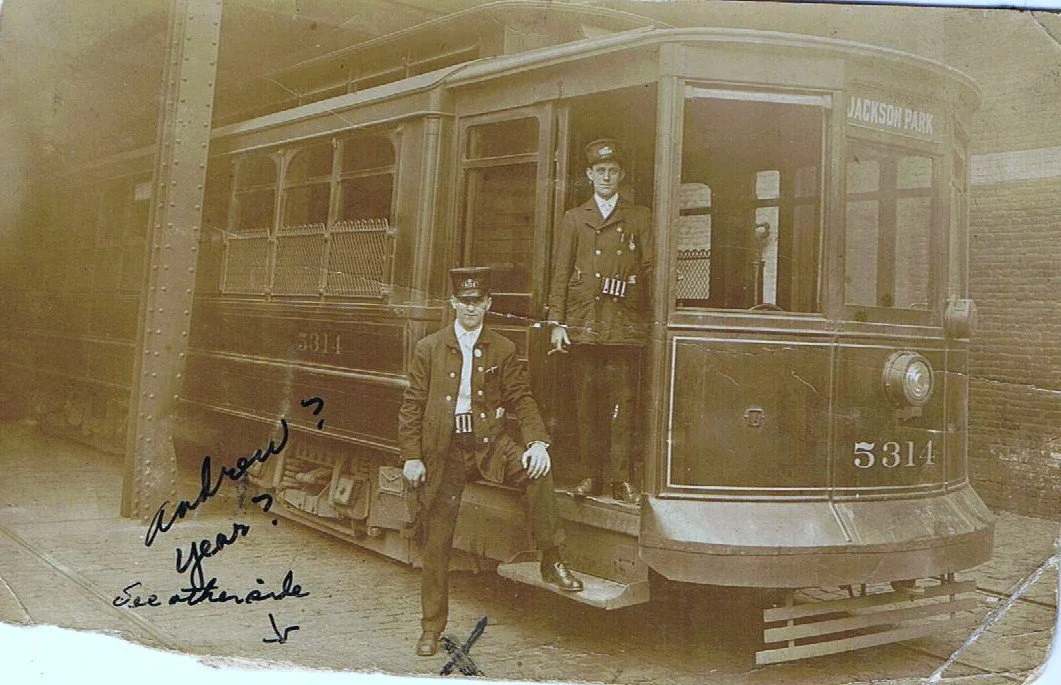
Great Grandfather, Andrew
(front outside Chicago trolly)
Me, the Page, and the Halfway Point
31 December 2025 - Wednesday
Tá an neart istigh ionat cheana féin.
The strength is already within you.
I’m excited (and slightly amazed) to share that I’ve officially reached the halfway point in writing my novel. What began as a quiet idea has grown into something alive, with characters who surprise me, scenes that move me, and themes that challenge me to go deeper. The process has been everything: exhilarating, maddening, slow, and sacred. Some days, the words come like a river. Other days, I wrestle with a single paragraph for hours. But what’s carried me through is the quiet promise I made to myself to finish, and the love I’ve developed for this story along the way.
Like many creative journeys, there have been moments of doubt, times I’ve questioned whether the arc was strong enough or if anyone would ever care about these characters the way I do. I’ve had to fight the urge to over-edit too soon and trust that the first draft doesn't have to be perfect, it just has to be real. Life has its interruptions, and writing rarely happens in a vacuum. But still, I return to the page, even if it’s just a few hundred words at a time. And slowly, a story is unfolding that I’m proud of.
One title I keep returning to is Anam Cara, a phrase that has deeply influenced the soul of this novel. In Celtic tradition, Anam Cara means “soul friend”. It is someone with whom you share an intimate, spiritual connection that transcends time, distance, and even words. It’s a concept rooted in ancient Irish wisdom, a kind of relationship where masks fall away and presence is enough. This theme of soul-level connection, of being truly seen, runs like a current beneath the narrative. Whether or not it becomes the final title, it’s certainly the heart of what I’m writing.
While a few people know I’ve been working on this novel, not one has ever asked how it’s going , and I’ll admit, that’s been a little disappointing. Writing can be such a solitary act, and in those quiet stretches, a small gesture of interest can mean a lot. But in the absence of that external encouragement, I’ve come to realize that the story itself has become my support. It holds me accountable, challenges me, and keeps showing up for me, even when no one else does. There’s something strangely empowering about that. I’m not writing for applause or validation. I’m writing because this story matters, to me first, and hopefully one day, to someone else.
The Watching Place
26 June 2025 - Thursday
“Not all doors are crossed. Some are kept.”
— old Irish saying
(Chapter excerpt)
There is a place where I am strongest.
It is not marked on any map.
It has no name the living would recognize.
But everything that matters passes through it eventually.
The Watching Place is not a clearing, though it often looks like one. It is not a tree, though trees lean toward it. It is not a memory, though memory thickens there like fog.
It is the pause.
The moment just before a choice is made.
The breath held without knowing why.
I learned it long before I died.
As a boy, I felt it in the pines when storms gathered but had not yet broken. As a man, I stood in it when words failed and silence had to be chosen carefully. When I crossed over, it was the first place I understood clearly.
Watching is not passive.
It is an act of restraint.
The living think intervention is power. They are wrong. True power is knowing when not to touch a thing. Knowing when presence alone will bend the path.
From the Watching Place, I see without being seen.
I see Lisa when she stills, when her thoughts slow and her body speaks first. I feel the echo in her chest when old fear tries to dress itself as caution. I recognize the way her shoulders tense when memory approaches sideways.
She is closer now.
Not to answers.
To herself.
“ I was not lost—I was being led. Abandoned by one history, I was claimed by another. The blood of my ancestors was a map, and Maine was always the destination written in my soul."
I am currently working on a novel based in part on my personal life experiences. Writing this book has been an emotional and transformative experience—one that has redefined my understanding of identity, resilience, and the invisible threads that connect us to our past. What started as a personal journey has evolved into something far greater: a rediscovery of where I come from and, in many ways, who I am.
In tracing the steps of my great-great-grandfather—a man I never knew existed—I’ve uncovered a story that feels both foreign and deeply familiar. "From the bustling streets of Southside Chicago to the rugged coast of Maine," our paths are interwoven in ways I never imagined. He walked streets I now call home, breathed the same salty air that fills my lungs. Through his story, I find echoes of my own struggles, triumphs, and spirit.
There’s something deeply healing about this process, something grounding. In peeling back the layers of history, I’ve come to see my life not as an isolated experience, but as part of a larger, ongoing story. This discovery has been more than historical curiosity—it has been a salve for the parts of me that once felt untethered.
This book is as much about my ancestors as it is about the universal longing for belonging. It’s about the power of lineage, the strength of resilience, and the beauty of uncovering pieces of yourself in the most unexpected places. More than anything, it’s a testament to the idea that "some connections are indeed written in the stars."
As I continue writing, I find myself more connected—not just to my ancestors, but to myself. And perhaps that’s the greatest discovery of all.
Stay tuned as I share more pieces of this journey. If you've ever wondered about the stories hidden in your own roots, I hope my words encourage you to start digging—you never know what you might find.
~ Lisa
Writing, Wandering, and Wondering
February 12, 2025 - Wednesday
“Ultimately, what matters is the commitment to continue— writing is not just what I do; it’s where I discover meaning, purpose, and the deepest parts of myself.”
When I first envisioned writing a novel, I imagined an idealized version of the process—waking up early, sipping coffee in a cozy nook, and effortlessly typing away as words poured onto the page. In reality? My writing routine is a mix of structure, unpredictability, and sheer willpower. Some days, the words flow with ease. Other days, I stare blankly at my screen, rereading the same sentence over and over, questioning my entire existence and wondering if I should take up knitting instead.
But through trial and error, I’ve discovered a rhythm—a routine that, while far from conventional, keeps me moving forward. Here’s what a good writing day looks like for me (because, let’s be honest, the bad ones deserve their own post).
Mornings, Coffee, and Four Golden Retrievers
I’m most productive in the early hours of the morning—when darkness still lingers over the Maine woods outside my house. But before I even think about writing, my day begins with love and cookies for my four Golden Retrievers: Dandelion, Seamus, Stormy, and Alfred. Then comes coffee. Lots of coffee.
As I sip my first cup, I tell myself I should dive straight into writing. Instead, I get caught up in emails, check messages, or convince myself that reorganizing my desk is an essential part of the creative process. I might even tackle random tasks from my to-do list, anything to delay the inevitable.
Easing Into the Writing Process
After realizing I’ve spent 45 minutes doing everything except writing, I force myself to focus. But even then, I don’t immediately start drafting. Instead, I ease into it by rereading what I wrote the day before. This accomplishes two things:
It helps me remember where I left off.
It tricks my brain into believing I’m making progress (even when I’m mostly just editing).
Mostly the latter.
By the time I’m on my second cup of coffee, I finally start writing. Some days, it’s just a few hundred words; on really good days, it’s a few thousand. But I try not to obsess over word count, because progress isn’t always about numbers—it’s about consistency. I don’t write all day, or even every day, but I do write most days. And sometimes, writing means deleting paragraphs that aren’t working. Other times, it’s about deepening a scene’s emotional impact instead of rushing through it. On occasion, it’s simply capturing an idea or experience that might later weave its way into my story.
The Art of Taking Breaks
Writing is mentally exhausting, and I’ve learned that stepping away is often the best thing I can do. My breaks involve grabbing a snack, or going down an unnecessary research rabbit hole (because suddenly, I need to know what Chicago streetcars looked like in 1900).
Then there are the days when I sit at my desk, convinced my novel is a disaster, wondering why I ever thought I could write in the first place. Self-doubt is a constant companion in my writing process, but I’ve learned to expect it and push through. When I hit a wall, I do something to shift my mindset—sometimes by rereading a section I actually like, just to remind myself that I can write. Other times, I step away completely—watching a show, painting, drawing, or doing anything unrelated to writing. More often than not, taking a break allows me to return with a clearer mind.
The Key to Writing: Showing Up
What matters isn’t having a perfect routine—it’s showing up, even when it’s hard. It’s finding joy in the process, even on the days when every sentence feels like a battle. And, most importantly, it’s understanding that every word I write brings me one step closer to telling the story I was meant to tell.
Final Thoughts
If there’s one thing I’ve learned, it’s that there is no “right” way to write a book. Some writers wake up at 5 AM and power through hours of writing before the world stirs—that’s how I work best. Others embrace a process that’s part discipline, part chaos, and completely fueled by caffeine—also me. Ultimately, what matters is the commitment to continue—the quiet resolve to return to the page, even when doubt lingers and inspiration wanes. Because even on the hardest days, writing is not just what I do; it’s where I discover meaning, purpose, and the deepest parts of myself.